
Builders.
Dreamers.
Questioners.

Photograph sources & credits
Original photographic pixels, with background areas hidden by a collage mask; no AI reconstruction. Herzl: Carl Pietzner, 1896, public-domain source. Weizmann: Robert Sennecke, 1925, public-domain source. Historical figures are not presented as endorsers of this essay.UNCURIOUS · 04
What We Built, and What It Cost Us
Victims of Our Own Success
And now we are victims of our own success. The newer generations inherited a country that their grandparents bled for and their parents built, and somewhere in the transfer something got lost. Not the country — the memory of what it cost. Complacency is a luxury, and we have been able to afford it just long enough to start fighting among ourselves. Which is, if you squint at it, deeply Jewish. We didn't get along when we had a kingdom the first time either. You could argue that sovereignty is what broke us then. Maybe that's in the code too.
But here's what doesn't get said enough about the infighting, the internal friction, the noise of Israeli political life — underneath all of it, something extraordinary is happening that has never happened before in our history. We are coalescing. For the first time since the tribes, Jews from every corner of the earth are not just living alongside each other but building families together. The Ashkenazi grandmother from Warsaw and the Sephardic grandmother from Fez are raising grandchildren in the same country, and those grandchildren are marrying each other's grandchildren. That's not immigration. That's a reunion.
And the most vivid evidence of that reunion isn't in the Knesset or in the army — it's on the plate. Israeli cuisine is what happens when the ingathering actually works. The Yemenite jachnun, the Moroccan matbucha, the Persian herb frittata, the Polish-Jewish schnitzel — all of it landing on the same table, seasoned with each other, cross-pollinating in ways that required a country to make possible. You want proof that we are one people? Eat in Tel Aviv for a week.
Take shakshuka. North African Jews brought versions of eggs poached in spiced tomato sauce with them when they made aliyah. Add the white cheese familiar across the Balkans and the eastern Mediterranean, and you have an Israeli kitchen doing what kitchens do: bringing people's lives together in a pan.
Food travels. It acquires accents. You can recognise its origins without pretending that a dish needs a passport. For me, that table is the ingathering made edible.
Which brings us to Sabra, founded in Queens in 1986 and now wholly owned by PepsiCo. Its story is one small example of Middle Eastern food becoming part of everyday American life. I'm more interested in that exchange than in treating a supermarket aisle as a border dispute. They can have the argument about the tomatoes. We'll take the dish.
The ingathering in a pan
Shakshuka with Bulgarian cheese. Put it in the middle of the table. Bring bread. Let everyone argue over the last egg. There are worse ways to understand a people.
Food history note: Sabra’s company history records its founding and the December 2024 change in ownership.
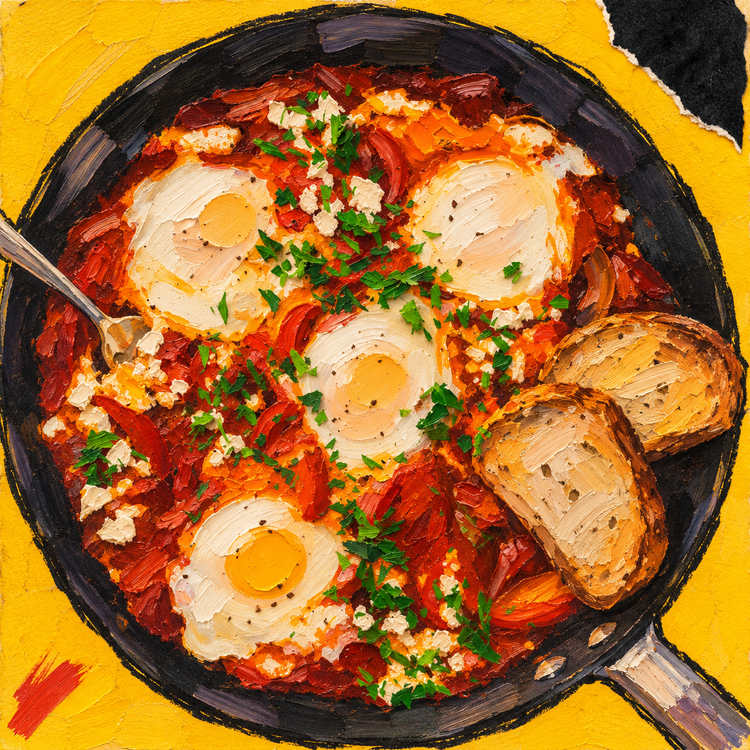


Michael Solomonov’s shakshuka
Adapted from Zahav by Michael Solomonov and Steven Cook · Half batch, serves 4
For the pan: ¼ cup olive oil, divided; 1 chopped onion; 2 chopped bell peppers; 3 sliced garlic cloves; 1 tbsp ground dried lime (optional); 3 tbsp sweet paprika; 1 tsp each ground cumin and coriander; ¼ tsp kosher salt; 4 cups tomato purée; 2 tsp sugar; 8 large eggs; sliced serrano and chopped cilantro to finish.
- Warm half the oil over medium heat. Add the onion, peppers, garlic, spices and salt. Cook for about 10 minutes, until the vegetables soften without browning.
- Add the tomato purée and sugar. Simmer 10–12 minutes, until the sauce reduces by about a third, then stir in the remaining oil.
- Crack the eggs into the sauce. Cover and cook over low heat for about 5 minutes, until the whites set. Top with serrano and cilantro and bring the pan to the table.